The Care Labeling Rule—often referred to as the Care Labeling Act—is a federal regulation that governs how care instructions must be provided on clothing sold in the United States. Enforced by the Federal Trade Commission (FTC), the rule exists to protect consumers and ensure garments can be properly cleaned without damage.
For apparel brands and manufacturers, understanding the Care Labeling Rule is essential to staying compliant and avoiding costly mistakes.
And for additional information on what a care label is, check our article.
What Is the Care Labeling Rule?
The Care Labeling Rule requires that most garments sold in the U.S. include permanent, accurate care instructions. These instructions must tell consumers how to safely clean the garment using ordinary household methods.
The rule applies to clothing intended for:
- Retail sale
- Wholesale distribution
- Uniform and workwear programs
Care instructions must be attached to the garment at the point of sale.
Who Must Comply?
The Care Labeling Rule applies to:
- Apparel brands
- Clothing manufacturers
- Importers
- Private-label sellers
Even if garments are manufactured overseas, any clothing sold in the United States must comply with FTC care labeling requirements.
What Information Is Required?
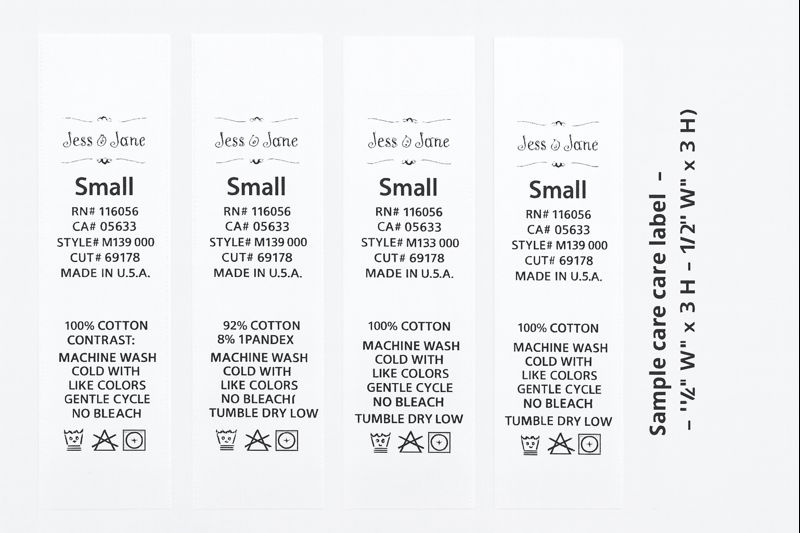
Under the Care Labeling Rule, garments must include instructions for at least one safe cleaning method. Care labels typically address:
- Washing instructions
- Bleaching instructions
- Drying instructions
- Ironing instructions
- Dry cleaning instructions (if applicable)
If a garment cannot be safely cleaned using water, the label must clearly state that limitation.
Permanence and Legibility Requirements
Care labels must be:
- Permanent – securely attached and not easily removable
- Legible – readable throughout the life of the garment
- Accurate – based on reliable testing or experience
Hang tags or packaging alone do not meet the permanence requirement.
Where Must Care Labels Be Placed?
The rule does not mandate a specific placement, but labels must be:
- Easy to locate
- Easy to read
Common placements include side seams, inside neck seams, waistbands, or hems.
Are There Any Exceptions?
Certain items are partially exempt or have modified requirements, such as:
- Some accessories
- Items that are not intended to be cleaned
However, most everyday apparel requires a care label. Brands should verify exemptions carefully before assuming they apply.
Why the Care Labeling Rule Matters
Failure to comply can lead to:
- FTC enforcement actions
- Relabeling costs
- Delayed shipments
- Retailer rejections
Beyond compliance, proper care labeling:
- Reduces consumer complaints
- Protects garment performance
- Builds trust in the brand
Best Practices for Compliance
Apparel brands that stay compliant typically:
- Use permanent, sew-in care labels
- Choose durable materials that withstand washing
- Test garments before finalizing instructions
- Keep labeling consistent across production runs
The Care Labeling Rule is a foundational requirement for apparel sold in the U.S. Clear, permanent care labels protect consumers, reduce risk, and help brands operate smoothly at scale. Treating care labels as an afterthought can lead to unnecessary delays and compliance exposure.
Need help with FTC-compliant care labels?
Lee Label supplies woven, satin, and cotton care labels designed to meet U.S. Care Labeling Rule requirements for apparel brands and manufacturers.
 Lee Label Inc
Leave a comment