If you manufacture, import, or sell apparel in the United States, care labels are not optional. They are a legal requirement enforced by the Federal Trade Commission (FTC) and play a critical role in consumer safety, compliance, and brand credibility.
This article breaks down exactly what information is required on a U.S. care label, why it matters, and common mistakes that can put brands at risk.
Why Care Labels Are Legally Required
Care labels exist to ensure consumers know how to properly clean and maintain garments without causing damage. Improper or missing care instructions can lead to:
- Consumer complaints
- Product returns
- FTC enforcement actions
- Costly relabeling or production delays
For manufacturers and brands, care labels are both a compliance obligation and a risk management tool.
The FTC Care Label Rule
The FTC’s Care Label Rule requires that most textile wearing apparel sold in the U.S. include a permanent care label that provides clear instructions for ordinary use.
The rule applies to:
- Apparel manufacturers
- Importers
- Private label brands
- Wholesalers and retailers
Responsibility typically falls on the company that introduces the product into U.S. commerce.
Required Information on a U.S. Care Label
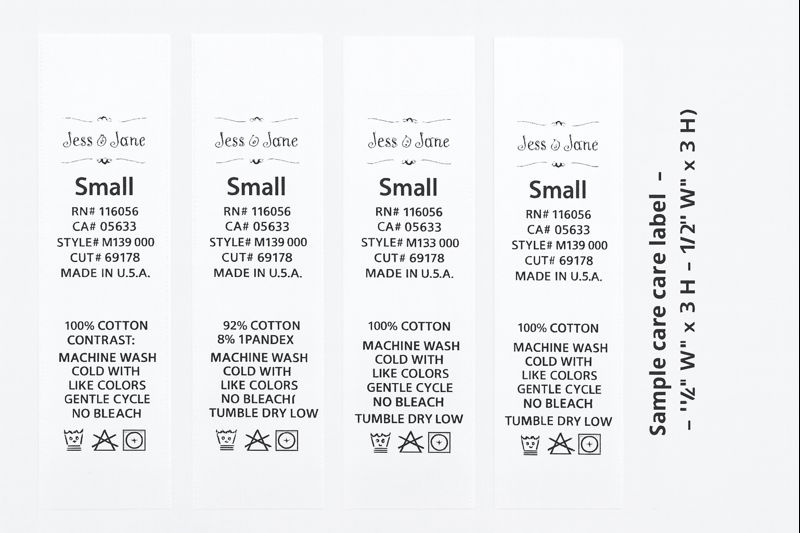
At a minimum, a compliant care label must include the following:
1. Washing Instructions
The label must clearly state how the garment should be washed, including:
- Machine wash or hand wash
- Water temperature (hot, warm, cold)
- Any special conditions (gentle cycle, wash separately, etc.)
If washing is not recommended, the label must clearly state that.
2. Bleaching Instructions
You must specify whether bleaching is:
- Allowed
- Allowed only with non-chlorine bleach
- Not allowed
If bleaching could damage the garment, this must be clearly indicated.
3. Drying Instructions
The care label must explain how to dry the garment, such as:
- Tumble dry (with heat level if applicable)
- Line dry
- Lay flat to dry
- Do not tumble dry
4. Ironing Instructions
If ironing is appropriate, the label should include:
- Whether ironing is allowed
- Recommended temperature (low, medium, high)
- Any precautions (iron inside out, do not iron decoration, etc.)
If ironing could cause damage, the label must say “Do Not Iron.”
5. Dry Cleaning Instructions (If Applicable)
If dry cleaning is recommended or acceptable, the label must specify:
- Whether dry cleaning is allowed
- Any restrictions (use petroleum solvent only, etc.)
If dry cleaning would damage the garment, the label must clearly prohibit it.
Additional Required Information (Often Overlooked)
Beyond care instructions, most apparel sold in the U.S. must also include:
Fiber Content
- Listed in descending order by percentage
- Using FTC-approved fiber names
Country of Origin
- “Made in USA,” “Made in China,” etc.
- Must comply with country-of-origin rules
Manufacturer or RN Number
- Company name or FTC-issued RN (Registered Identification Number)
While these elements may appear on separate labels, they are often combined with care labels for efficiency.
Label Placement and Permanency Requirements
The FTC requires care labels to be:
- Permanent (able to withstand washing)
- Legible throughout the garment’s life
- Attached at the point of sale
This is why woven or satin sew-in labels are commonly used instead of stickers or temporary tags.
Common Care Label Compliance Mistakes
Some of the most frequent issues we see include:
- Missing care labels entirely
- Instructions that contradict fabric performance
- Labels that fade or wash out
- Incorrect fiber content listings
- Using non-standard wording or symbols only
These mistakes can delay shipments, trigger relabeling costs, or cause compliance issues during audits.
Why Professional Care Labels Matter
Care labels are not just a legal checkbox — they reflect the quality and professionalism of your brand. Durable, legible labels help:
- Reduce customer complaints
- Protect against liability
- Streamline production at scale
- Meet retailer and distributor requirements
For uniforms, safety apparel, and outdoor gear, material choice and print clarity are especially important.
Understanding what information is required on a care label in the U.S. is essential for any apparel business operating at scale. Getting it right from the beginning saves time, money, and risk down the line.
If you’re unsure whether your current labels meet U.S. requirements, it’s worth reviewing both the content and the construction of your labels before production.
Need compliant care labels for your garments?
Lee Label works with brands, manufacturers, and industrial clients to produce durable, U.S.-compliant care labels at scale. Samples and consultations available.


Leave a Reply