Care labels are a required component of most garments sold in the United States. They provide consumers with instructions on how to properly care for a piece of clothing and help manufacturers meet federal labeling requirements.
While often small and overlooked, care labels play a critical role in consumer protection, compliance, and product longevity.
What Is a Care Label?
A care label is a permanent label attached to a garment that communicates how the item should be cleaned and maintained. Care labels are regulated in the U.S. by the Federal Trade Commission (FTC) under the Care Labeling Rule.
The purpose of a care label is to ensure consumers receive clear, accurate instructions to avoid damaging the garment during normal use.
What Information Is Included on a Care Label?
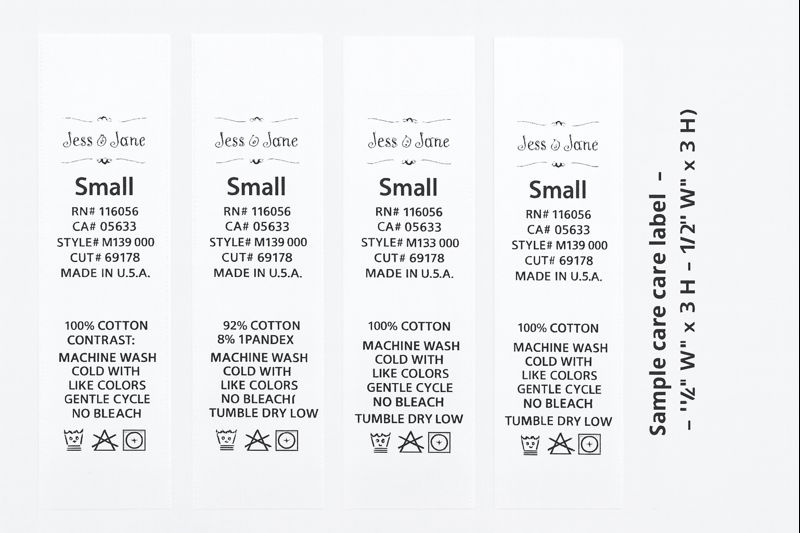
A standard U.S. care label typically includes:
- Washing instructions (machine wash, hand wash, water temperature)
- Bleaching instructions (if bleach can or cannot be used)
- Drying instructions (tumble dry, line dry, heat level)
- Ironing instructions (temperature or “do not iron”)
- Dry cleaning instructions (if applicable)
In many cases, care labels are combined with:
- Fiber content information
- Country of origin
- Manufacturer name or RN number
Are Care Labels Legally Required?
In the United States, most garments are required to have a care label. The FTC requires that care instructions be:
- Permanent
- Legible
- Accurate
- Attached to the garment at the point of sale
Relying on hang tags or packaging alone is not sufficient, as these can be removed and do not meet permanence requirements.
Here is an article on what information is required to be on care labels.
Why Care Labels Matter
Care labels serve several important functions:
Consumer Protection
They help consumers care for garments properly, reducing damage caused by incorrect washing or drying.
Compliance
They allow manufacturers and brands to meet FTC labeling requirements and avoid enforcement issues.
Reduced Returns
Clear care instructions reduce customer dissatisfaction and returns caused by garment damage.
Brand Credibility
Well-made, durable care labels signal professionalism and quality control.
Where Are Care Labels Placed?
Care labels are commonly sewn into:
- Side seams
- Inside neck seams
- Waistbands
- Inside hems
Placement depends on garment type, design, and brand standards, but labels must be easy to locate and read.
Common Care Label Materials
Care labels are typically produced using materials designed to withstand repeated washing:
- Woven polyester labels – highly durable and resistant to fading
- Satin labels – soft, commonly used for fashion and interior placement
- Cotton labels – used for certain natural or specialty garments
Material choice depends on garment use, wash conditions, and comfort requirements.
Care Labels vs. Hang Tags
Care labels should not be confused with hang tags.
While hang tags are used for branding and pricing, they do not replace care labels because they are removable and not permanent.
Only sewn-in labels meet FTC permanence requirements.
Care labels may be small, but they are essential. They protect consumers, support compliance, and help garments perform as intended over time. For apparel brands and manufacturers, care labels are not an optional detail—they are a foundational part of responsible production.
Need compliant care labels for your garments?
Lee Label supplies woven, satin, and cotton care labels designed for durability, clarity, and large-scale apparel production.
 Lee Label Inc
Leave a comment