If you sell products in California, you may have heard about Proposition 65 (Prop 65)—and wondered whether you actually need warning labels to stay compliant. The short answer is: sometimes yes, sometimes no, depending on the product and exposure risk.
This article explains when Prop 65 labels are required, who is responsible, and how businesses typically handle compliance.
What Is Proposition 65?
Proposition 65 is a California law that requires businesses to provide warnings when products expose consumers to certain chemicals known to the State of California to cause cancer, birth defects, or other reproductive harm.
The law applies to products sold, shipped, or distributed into California, regardless of where the company is located.
Are Prop 65 Labels Always Required?
No. A Prop 65 warning is required only if a product exposes consumers to a listed chemical above the established safe harbor level.
If exposure is below that level, a warning is not required. However, determining exposure often requires testing or documentation—something many businesses do not have readily available.
Why Many Businesses Use Prop 65 Labels Anyway
Because testing and exposure analysis can be costly and time-consuming, many businesses choose to apply Prop 65 warnings proactively. This is often referred to as a “safe harbor” approach.
Using a compliant warning label can:
- Reduce compliance risk
- Avoid enforcement actions
- Prevent distribution delays
- Provide clarity to retailers and distributors
For apparel and consumer goods, warnings are commonly used as a precaution.
Who Is Responsible for Prop 65 Compliance?
Responsibility typically falls on:
- Manufacturers
- Brand owners
- Importers
- Distributors
Retailers may also require confirmation that products are Prop 65 compliant before accepting inventory.
Where Do Prop 65 Warnings Need to Appear?
Prop 65 warnings must be:
- Clear and reasonable
- Visible at the point of sale
Depending on the product, warnings may appear:
- On the product itself (sew-in labels for apparel)
- On packaging
- On hang tags
- On online product listings
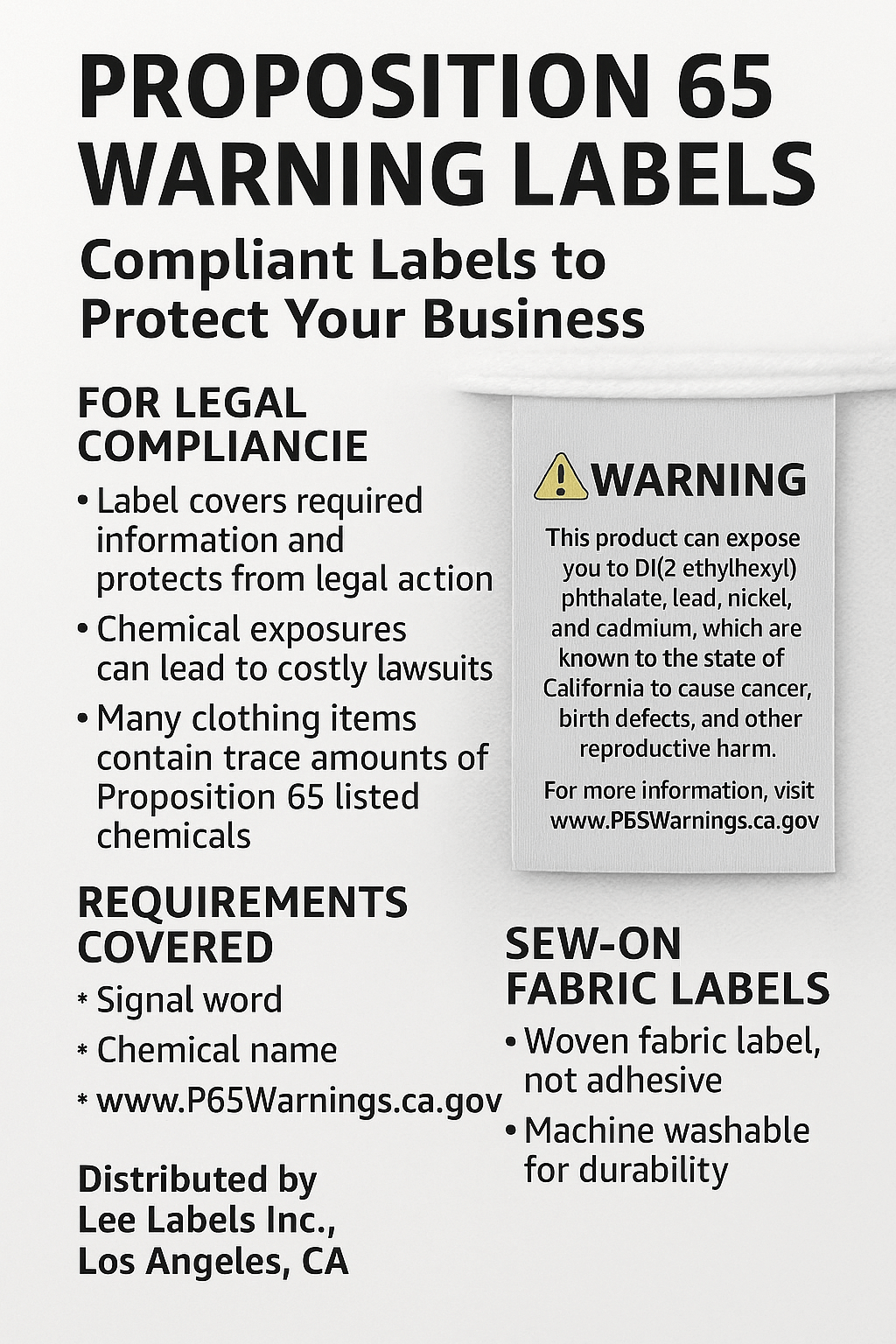
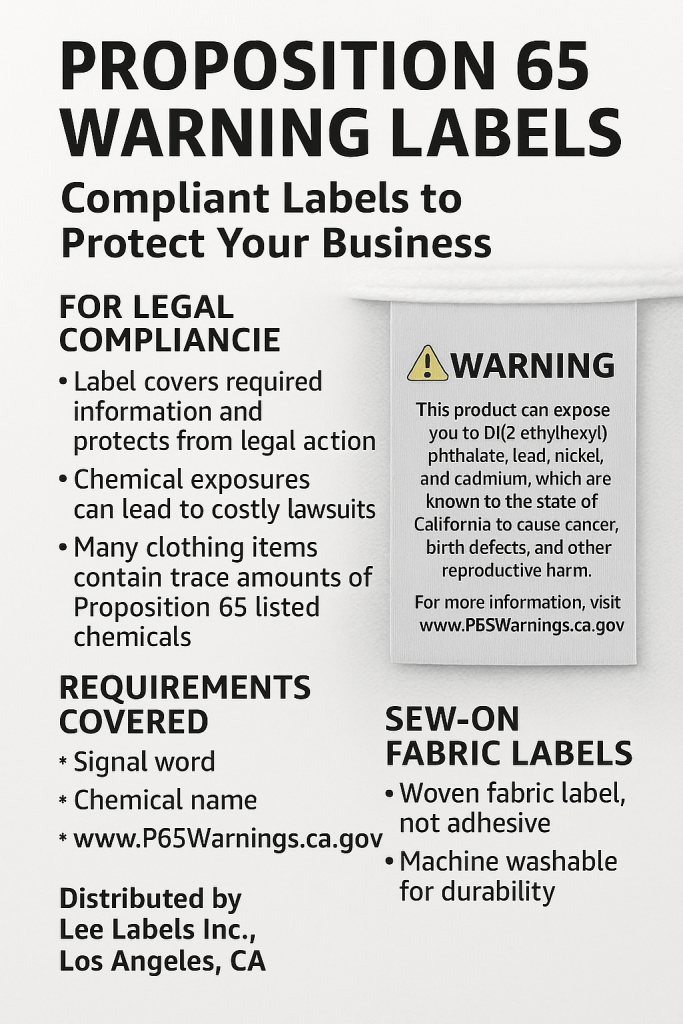
For sewn apparel, permanent sew-in labels are often used to ensure warnings remain attached to the product.
Do Online Sellers Need Prop 65 Warnings?
Yes. If you sell products online to California customers and the product requires a warning, Prop 65 warnings must be displayed before purchase, typically on the product page.
This applies even if your business is located outside California.
What Happens If You Don’t Use Prop 65 Labels?
Failure to comply can result in:
- Enforcement actions
- Legal notices
- Costly settlements
- Product holds or relabeling
Penalties can reach up to $2,500 per violation per day, making compliance an important consideration for businesses selling into California.
Common Products That Use Prop 65 Labels
Prop 65 warnings are commonly found on:
- Apparel and textiles
- Consumer goods
- Tools and hardware
- Furniture
- Outdoor and safety gear
The presence of a label does not necessarily mean a product is unsafe—it indicates compliance with California disclosure requirements.
You do not automatically need a Prop 65 label to sell in California—but if your product exposes consumers to listed chemicals above safe levels, a warning is required. Because determining exposure can be complex, many businesses choose to use Prop 65 labels as a precautionary compliance measure.
Need Prop 65 labels for your products?
Lee Label supplies both sew-in Prop 65 warning labels and adhesive warning stickers designed for durable, compliant use across apparel and consumer products.
 Lee Label Inc
Leave a comment